
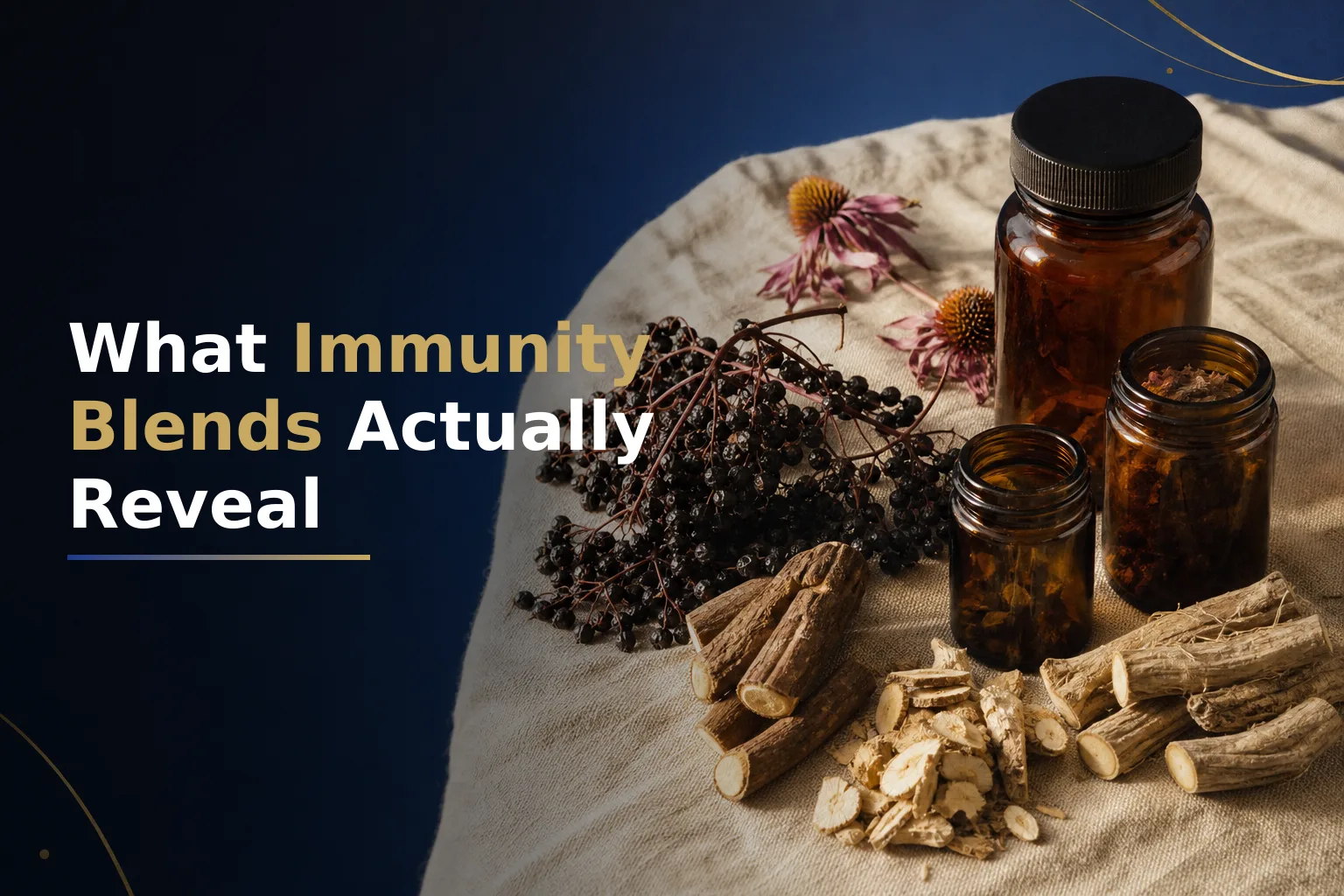
The word "proprietary" appears on the label of nearly every multi-ingredient immunity supplement sold today. Legally, that designation protects a trade secret: the exact amounts of individual ingredients do not have to appear on the label. But by itself, it does not protect the quality of what is inside the bottle.
A careful supplement buyer can use this understanding.
What Labeling Law Requires and Leaves Open
Under U.S. federal regulation, a supplement containing a proprietary blend must list the blend's total weight and name every ingredient within it in descending order by weight, as detailed in the NIH Office of Dietary Supplements guide on dietary supplements. The law does not require disclosure of each ingredient's individual amount.
The practical result: two immunity supplements with identical label copy can contain entirely different quantities of the same herbs. A product listing elderberry before echinacea confirms only that elderberry is present in greater quantity by weight. It says nothing about whether either ingredient is present at any dose the clinical literature has actually examined.
The Standardization Paradox
A common substitute for per-ingredient transparency is a standardization percentage - "standardized to 4% echinacosides" or "standardized to 5% polyphenols." This approach has merit but has limits.
A 2016 review in Nutrients examining bioactive predictability in herbal products found that standardization based on a marker compound "often yields unreliable results, especially when the chosen marker is not the biologically active component of the plant," and that "therapeutic effects may result from a complex interaction among various herbal constituents." The marker chosen for standardization is a manufacturing decision, not a clinical one. It controls what is convenient to measure, not what the evidence actually links to a meaningful effect.
Three Ingredients Worth Scrutinizing
Most herbal immune blends use the same herbs. Three show up frequently enough and have enough published research to deserve close examination, particularly for how dose-dependent the findings are.
Echinacea (Echinacea purpurea)
A systematic review of 19 controlled trials concluded that Echinacea preparations "can be efficacious immunomodulators." However, the review also noted that "evidence is still insufficient for clear therapeutic recommendations as to which preparation to use and which dose to employ." Dose differences appear to matter considerably. A 2023 randomized blinded controlled trial in adults with acute respiratory tract infections compared conventional formulations delivering 2,400 mg of Echinacea extract per day against higher-dose formulations delivering 16,800 mg/d during the first three acute days. The higher-dose group experienced faster viral clearance. A blend listing "Echinacea purpurea extract" without specifying individual weight may contain a dose an order of magnitude below the lower arm of that trial.
Elderberry (Sambucus nigra)
A 2016 randomized, double-blind, placebo-controlled trial in economy-class air travelers showed that people who took a standardized, membrane-filtered extract of Sambucus nigra experienced shorter cold duration and lower symptom scores compared with placebo. The preparation used was a defined, filtered extract, not whole dried berry powder. This distinction matters: "elderberry" on an immunity label without extract type and standardization detail describes a wide range of preparations, most of which have not been tested at doses comparable to those used in published trials.
Echinacea, Astragalus, and Glycyrrhiza in Combination
The combination question is equally relevant. A pilot study in human subjects assessed Echinacea purpurea, Astragalus membranaceus, and Glycyrrhiza glabra administered individually and together for seven days, measuring CD69 expression on CD4 and CD8 T cells by flow cytometry as an immune activation marker. In combination, the three herbs produced an additive effect on CD69 expression compared with any single herb alone. Pilot study limitations apply, but the finding raises a structural issue for undisclosed blends: without per-ingredient dose data, there is no way to assess whether a formulation is capturing a combination effect or delivering each herb at sub-threshold quantities.
What Genuine Transparency Looks Like
Label transparency in a herbal immune supplement requires several pieces of information. Together, the following distinguish a carefully formulated product from one assembled primarily for shelf appeal:
- Individual ingredient weights per serving, not only the total blend weight. Without per-ingredient disclosure, no comparison with any published clinical dose is possible.
- Extract ratio and standardized active compound named explicitly, not simply the plant name. "Echinacea purpurea aerial parts extract, 4:1, standardized to 4% cichoric acid" provides actionable information. "Echinacea purpurea extract 200 mg" does not.
- Country of origin and plant part used - root, aerial parts, berry, or seed. The same botanical sourced from different growing regions or harvested at different plant-part ratios carries substantially different chemical profiles.
- Third-party testing documentation covering identity verification, heavy metals, pesticide residues, mycotoxins, and microbial contamination. Published research on authentication of herbal supplements using next-generation sequencing shows what rigorous botanical verification looks like. Not all manufacturers do this, and the label will not tell you which kind you are holding.
For context on how origin and handling practices affect active compound levels, Black Seed Oil Thymoquinone Levels Depend on Origin applies the same sourcing lens to Nigella sativa - a close parallel for why country of origin matters in herbal formulations.
Once you check a formulation's sourcing, the next practical question is timing and dose frequency. Two Modes of Herbal Immune Dosing and When to Switch covers how preventive versus reactive dosing applies to herbal immune complexes.
Putting the Framework to Work
Ayurnomics's Myeloguard Herbal Immune, taken per manufacturer directions, is an herbal immune complex in this category. The questions worth asking about any immunity supplement - which herbs are present, at what extraction standard, from which region, and tested by whom - matter before purchasing. The product whose label answers these questions most thoroughly typically has the best formulation process. For a broader view of these supplements, the Immunity & Wellness collection is a practical starting point.
If you are taking prescription immunosuppressants, anticoagulants, or medications that interact with cytochrome P450 pathways, speak with your clinician before adding any herbal supplement to your routine. The same applies during pregnancy or breastfeeding.
¿Quieres más artículos como este? Únete al Círculo Íntimo y recibe una pieza cuidada cada domingo.