
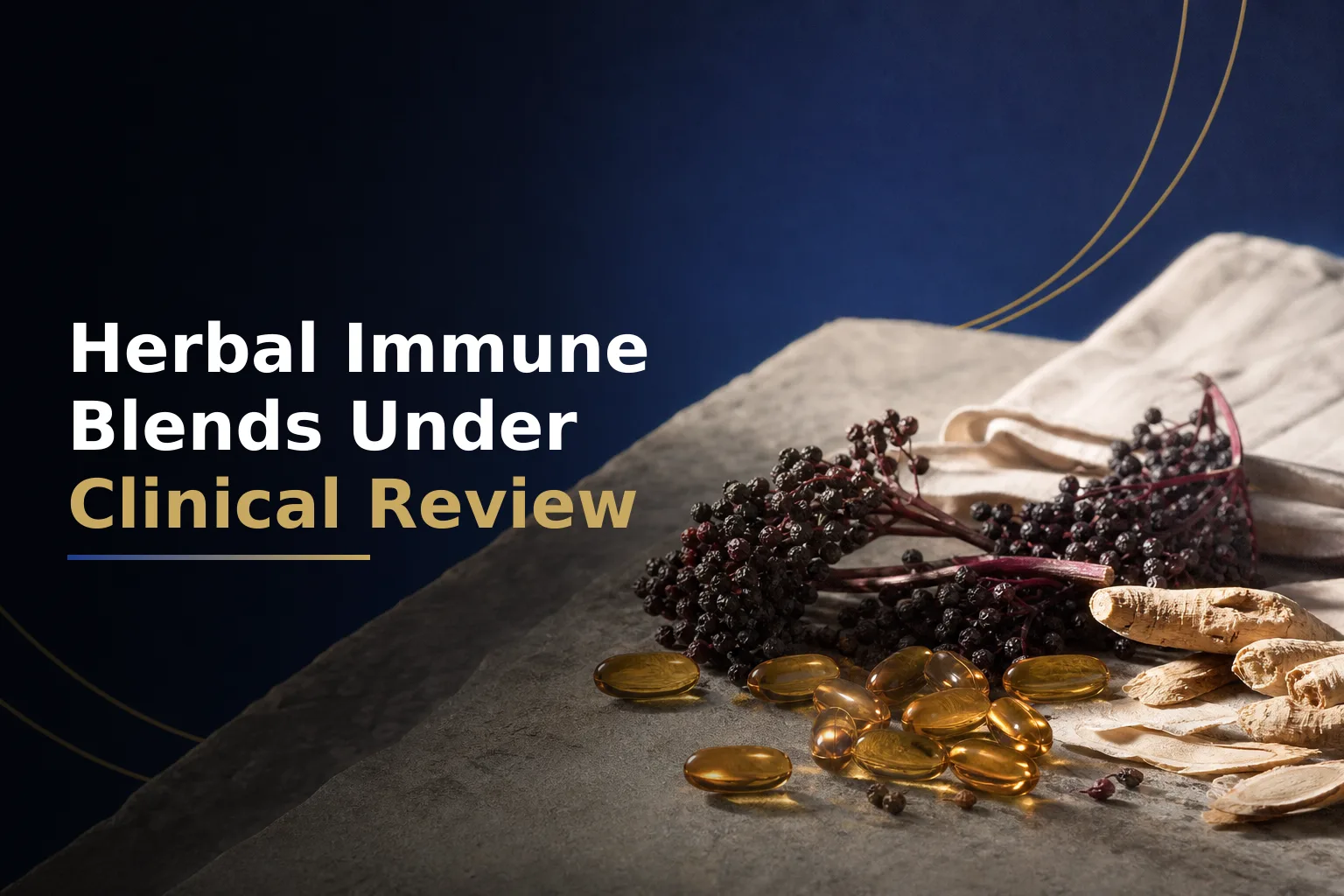
The supplement aisle has not been kind to herbal immune products. Vague ingredient panels and unverifiable claims have trained a generation of health-aware adults to flip every bottle over and look for the numbers. That habit is worth keeping. But skepticism of the whole category misses something: when a herbal immune formula uses well-studied ingredients at doses tested in humans, the research is stronger than most people expect.
This guide looks at the four herbal ingredients that appear most often in tested immune blends - Echinacea purpurea, Andrographis paniculata, Sambucus nigra (elderberry), and Astragalus membranaceus - and examines what the actual trials found. Not the front-of-label promise. What the trials measured, in which people, and at what doses.
A Word on Immunomodulation
Before looking at individual herbs, it helps to clarify the term that describes what these herbs do. Immunomodulation means a compound can shift immune activity in response to what your body needs. This is not the same as just ramping up immunity across the board. The real question is whether an herb moves immune markers in a direction linked to better outcomes: shorter respiratory illness, better cytokine responses when challenged, or stronger mucosal immunity under physical stress. That is what the better trials actually measure.
Echinacea purpurea: Preparation-Specific Effects
Echinacea is the most studied herb in the immunity category, which also means its failures are the most documented. Results from one extract do not automatically work for another. Dose, extraction method, and plant part all change the outcome.
A randomized, double-blind, placebo-controlled trial in Korean adults published in 2024 tested an ethanolic extract of Echinacea purpurea at 400 mg twice daily over eight weeks. The trial found a statistically significant increase in natural killer (NK) cell cytotoxic activity in the treatment group compared to placebo, along with increases in serum IL-2, IFN-gamma, and TNF-alpha. The preparation caused no adverse events across the full eight-week period.
Earlier evidence is more mixed. A randomized, double-blind, placebo-controlled trial of 755 healthy adults found that the reported duration of upper respiratory tract infections was significantly shorter in the Echinacea group than in the placebo group, even when the total number of infections did not differ between arms. This pattern - shorter or milder illness rather than prevented illness - recurs across multiple Echinacea studies and is arguably what this herb actually delivers.
Andrographis paniculata: A Narrower but More Consistent Evidence Base
Andrographis paniculata is less familiar than Echinacea but has stronger trial results in its specific area. It has been studied for uncomplicated upper respiratory tract infections. Its main active ingredient is andrographolide, a compound with anti-inflammatory and immune-activating properties shown in cell and animal studies.
A systematic review of randomized controlled trials concluded that Andrographis preparations were superior to placebo in reducing the severity and duration of uncomplicated upper respiratory infections, with an advantage of approximately 10.85 points in symptom scores favoring Andrographis. A separate randomized, double-blind, placebo-controlled trial using a standardized extract at 200 mg twice daily - standardized to 30 mg andrographolide per dose - found that overall symptom scores were significantly lower in the treatment group at day three and day seven compared to placebo, with faster recovery in the treated group. Safety data across pooled randomized trials showed a serious adverse event rate of approximately 0.02 per 1,000 patients.
Sambucus nigra: Duration Reduction Across Two Populations
Elderberry research includes lab work and human trials. The lab evidence - that elderberry polyphenols interact with viral proteins and change cytokine signaling - is solid in test tubes. What matters is whether human trials show consistent results in real people at defined doses.
A 2019 meta-analysis of randomized controlled trials found that elderberry supplementation was associated with a substantial reduction in upper respiratory symptoms, with a large effect size across the pooled dataset. In a separate randomized, double-blind, placebo-controlled trial of 312 economy-class air passengers - a high-exposure population - standardized elderberry extract at 300 mg twice daily significantly reduced cold duration and symptom severity compared to placebo. Like the Echinacea results, infection rates did not differ between groups, pointing to symptom relief as the main benefit rather than infection prevention.
A 2021 systematic review on elderberry's effects on viral respiratory illness concluded that the evidence is promising but limited by small sample sizes and different extract types across trials - a manufacturing issue that affects how any given product compares to the trial data.
Astragalus membranaceus: A Longer Time Horizon
Astragalus membranaceus works differently from the other three herbs. While Echinacea, Andrographis, and elderberry have most evidence for short-term acute use, Astragalus appears to build effects over weeks rather than block symptoms within days.
A 2023 systematic review and meta-analysis of human studies found that Astragalus supplementation significantly increased CD3 levels and raised the CD4/CD8 ratio, two markers of T-cell function, and reduced pro-inflammatory cytokines. Most studied doses corresponded to between 9 grams and 30 grams of dried root or comparable standardized extract - amounts not achievable through food alone.
The practical takeaway is that Astragalus works better as a maintenance herb than as a quick fix. Using it in a multi-herb formula alongside faster-acting herbs covers a timeline gap that no single ingredient can.
Why Combination Formulations Warrant Separate Scrutiny
The standard critique of proprietary herbal blends is valid: undisclosed ingredient ratios make it impossible to confirm clinically relevant doses. But this does not mean multi-herb formulations are worse than single-ingredient supplements.
The reason for combining these four herbs is that they work in different ways. Andrographis and elderberry appear to act during acute respiratory challenge, reducing symptom severity and duration over days. Astragalus works on a longer timeline, building the T-cell parameters that support baseline immunity. Echinacea may boost NK cell activation and mucosal immunity when taken regularly. A formula using all of these addresses different phases of immune function - a rationale that a single-ingredient product cannot match regardless of how good one ingredient is.
For a closer look at how sourcing decisions shape what gets into the capsule, see How Sourcing Standards Shape Myeloguard's Herbal Blend. For more detail on why herbal blends work well together, Why Herbal Blends Outperform Single Herbs for Immunity explains further.
Reading a Herbal Immune Formulation Honestly
Ayurnomics's Myeloguard Herbal Immune is formulated as a herbal immune complex. Take it as directed on the label. Like any product in this category, the front label is the least useful information. The ingredient panel, the standardization data for each active herb, and - where available - third-party lab test documentation are where evaluation starts. If a manufacturer will not supply that information, that itself tells you something.
If you want to add whole foods to your routine, try the Winter Immune Broth with Astragalus and Reishi.
What the Evidence Actually Shows
Echinacea, Andrographis, elderberry, and Astragalus work differently. Each has a different mechanism and different research support. Andrographis has the strongest evidence for uncomplicated upper respiratory infections at 200 mg twice daily of standardized extract. Elderberry has research support for reducing symptom burden at 300 mg twice daily of standardized extract, though preventing infection is less clear. Echinacea's effects depend on the preparation and show up most often in immune cell markers. Astragalus works best as a long-term herb, with effects on T-cell markers building over sustained use.
A herbal immune formula that uses all four - with clear standardization and transparent sourcing - has stronger research support than any single herb used alone. Whether a specific product meets this standard depends on formulation quality and manufacturer transparency, not on the category as a whole.
If you take prescription immunosuppressants, anticoagulants, or corticosteroids, speak with your clinician before adding any herbal immune product. Andrographis in particular has documented interactions with blood thinners. The same caution applies if you are pregnant or breastfeeding.
Explore the Immunity & Wellness collection for a broader view of evidence-led immune support, or review the full formulation details of Myeloguard Herbal Immune starting with the ingredient panel and working backwards from the trial doses cited above.
Vuoi altri contenuti come questo? Unisciti all'Inner Circle e ricevi un articolo curato ogni domenica.