
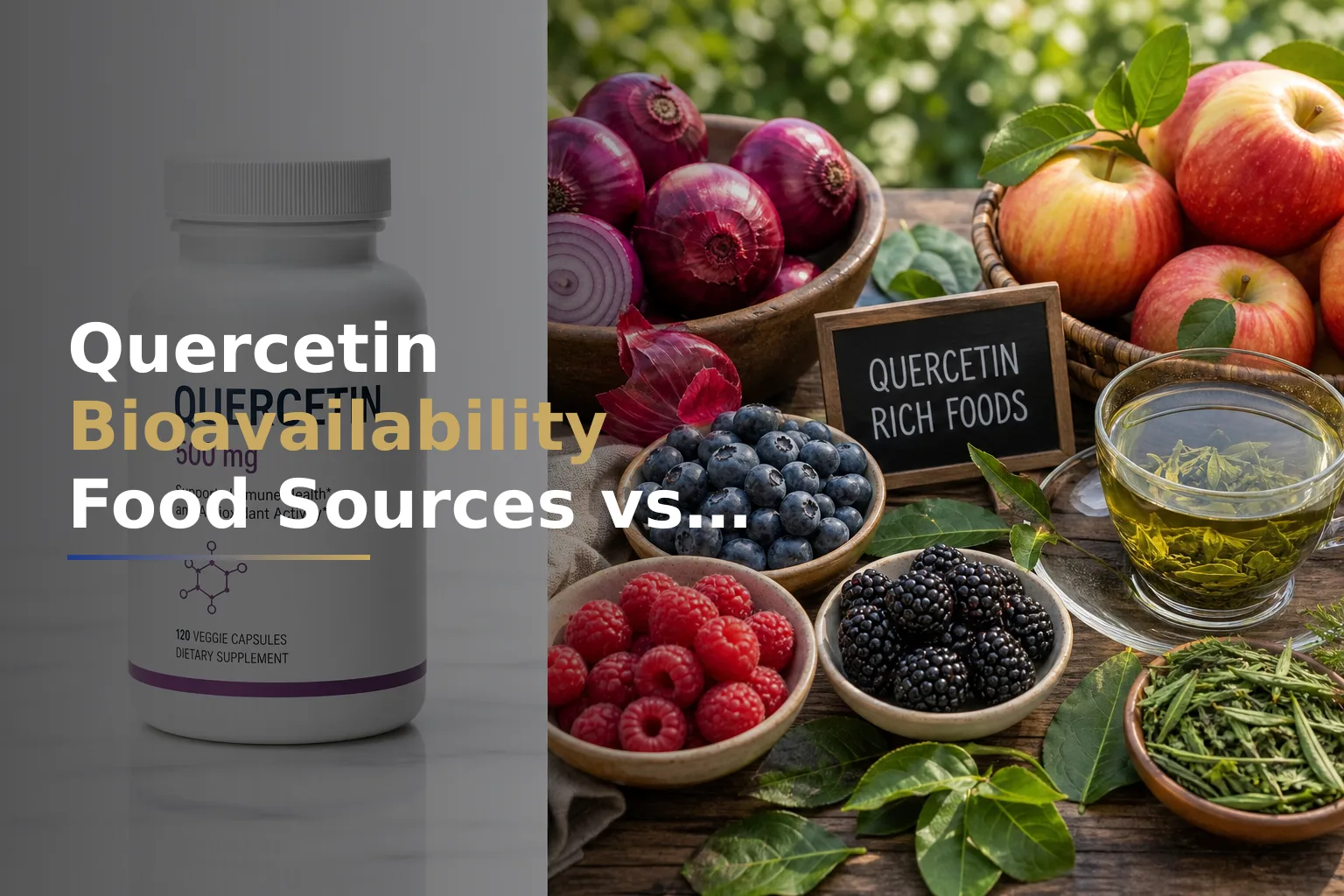
Quercetin sits on the supplement shelf next to promises like immune activator, histamine modulator, antioxidant frontrunner. The label rarely specifies which form of quercetin is inside the capsule. That single detail changes how much actually reaches your bloodstream. Two products with identical labeled doses can differ by nearly a factor of twenty in how much the body absorbs. The real difference comes down to molecular forms - worth understanding before you buy.
The molecule the label rarely explains
Quercetin is a flavonoid - specifically a flavonol - found in onions, capers, apples, leafy greens, and several other plant foods. In those foods it exists mostly bound to sugar molecules called glycosides. Quercetin-3-glucoside, the dominant form in onions, is one. Quercetin-3-rutinoside, found in buckwheat and rue, is another. When manufacturers strip those sugars away to produce a concentrated, shelf-stable powder, you get quercetin aglycone - the bare molecule. Most standard quercetin supplements on the market contain the aglycone form. That is the first thing the label is not telling you.
Why the aglycone form absorbs poorly
Quercetin aglycone is lipophilic and poorly soluble in water. Your gut wall and liver break it down substantially before it enters circulation. A pharmacokinetics study in healthy volunteers established that only approximately 5.3% of unchanged quercetin was bioavailable after oral aglycone dosing, even though total absorbed quercetin-related metabolites reached as high as 59.1% - because roughly 93% of the molecule is transformed in the gut wall before entering general circulation.
Those downstream metabolites retain some biological activity, but they are chemically distinct from quercetin itself. Most studies demonstrating specific immunological or anti-inflammatory effects were conducted with defined parent compounds, not with the metabolite mixture produced by aglycone breakdown. Treating 500 mg of aglycone as delivering 500 mg of bioavailable quercetin misrepresents how the pharmacokinetics work.
Glycosides and the absorption hierarchy
A 2025 systematic review and meta-analysis of human intervention studies - the most comprehensive review of quercetin bioavailability to date - found that quercetin-3-O-oligoglucosides were approximately 20-fold more bioavailable than quercetin aglycone, and roughly 10-fold more bioavailable than quercetin-3-O-rutinoside. This is not a marginal difference. It is an order of magnitude, driven by the sugar molecule attached to the quercetin backbone.
The mechanism is specific. Quercetin-3-glucoside is actively transported across the small intestinal wall via the sodium-dependent glucose transporter SGLT-1, allowing rapid uptake. (Established in human absorption research, 1999) Rutinoside cannot use that transporter. It must first be deglycosylated by colonic bacteria before absorption can begin - which is why peak plasma quercetin after rutinoside ingestion arrives roughly nine hours post-dose, compared to under 45 minutes after an onion-derived glucoside dose. The compound arrives more slowly and in smaller amounts, via a pathway that depends heavily on individual gut microbiota composition.
What crossover trials show about food versus capsule
A carefully controlled crossover study placed volunteers on defined quercetin loads from fried onions, apple peel, and a pure rutinoside supplement. Fried onions produced the highest peak plasma concentrations and the greatest area under the curve, outperforming apple peel and the rutinoside supplement substantially. A later study comparing quercetin capsules with apple-derived quercetin in humans confirmed that even at a similar dose, the food matrix changes outcomes: naturally occurring co-solutes in whole fruit - pectin, other polyphenols, plant cell wall components - appear to influence how quercetin moves through the gut in ways that isolates do not replicate.
Whole foods don't always win. What matters is comparing forms and matrices, not just milligrams on the label. A consistent habit of finely chopped raw onion delivers quercetin in a form your small intestine handles efficiently, which most standard aglycone capsules do not match.
Timing and the fat variable
The same 2025 meta-analysis found that co-ingestion of dietary fat approximately doubled quercetin bioavailability across studies. For a lipophilic compound, this makes biological sense: fat slows gastric emptying and assists the micellar solubilization that allows the molecule to reach the enterocyte brush border. Fiber had a more variable effect - modestly reducing peak plasma concentration in some trials while extending the absorption window in others.
The practical implication for anyone taking a quercetin supplement is direct: take it with a fat-containing meal, not fasted and not with plain water. Eggs, olive oil, avocado, or nuts provide the lipid environment the molecule needs. This is supported by meta-analysis of human data, and it costs nothing to implement.
The immunity claim, examined honestly
Quercetin's anti-inflammatory mechanisms are reasonably well characterized in cell-culture and animal models: it modulates NF-kB, inhibits mast cell degranulation, and interacts with cytokine-regulating pathways. (Mlcek et al., Nutrients, 2016) Those mechanistic findings are real and have driven substantial research interest.
The translation to measurable immune endpoints in healthy adults has been less consistent. A 12-week randomized trial supplementing healthy adult women with 500 mg or 1,000 mg quercetin daily found no statistically significant effect on natural killer cell activity, granulocyte oxidative burst, or granulocyte phagocytic function. Plasma quercetin levels rose in both groups - confirming absorption - but the innate immune markers measured did not shift. This does not dismiss quercetin as a compound. It does suggest that raising plasma quercetin in people with intact immune function may not produce detectable changes in the specific parameters this study examined. Research in populations with chronic inflammatory burden, or under exercise-induced physiological stress, continues and shows different patterns.
When a standardized supplement may make sense
Consistent daily doses above what a typical varied diet reliably provides require supplementation by definition. If you are exploring whether quercetin's studied effects on histamine pathways, oxidative stress response, or post-exercise recovery are relevant to your situation, a formulation with a verified form and a standardized dose removes the variability inherent in food-based intake.
Ayurnomics's Quercetin Daily 1.0 G delivers 1 gram of quercetin per serving - the dose range examined in 12-week human safety studies - as a standardized formulation. Taking it alongside a fat-containing meal, as the bioavailability evidence supports, is a rational practice. Per manufacturer directions on cycle length and frequency.
Reading the label differently
When evaluating a quercetin product, the useful information is not the total milligrams alone. The form matters: aglycone, glucoside, rutinoside, and phytosome complexes each carry different absorption profiles. A label that reads only '500 mg quercetin' without specifying form or recommending food co-ingestion tells you very little about what you will absorb. The dose in the bottle and the dose reaching your tissues are two different numbers, and the molecular form determines most of the distance between them.
For readers already thinking about how meal timing shapes supplement outcomes, our piece on berberine timing and dosing frequency covers the same principle applied to a metabolic context. And for those approaching quercetin from a seasonal immunity standpoint, our breakdown of vitamin D and zinc dosing windows for winter immunity examines comparable timing evidence for two other well-studied compounds.
To see the full range of quercetin and immunity-related formulations we carry - with sourcing and dosing information included - visit the Immunity and Wellness collection.
¿Quieres más artículos como este? Únete al Círculo Íntimo y recibe una pieza cuidada cada domingo.