
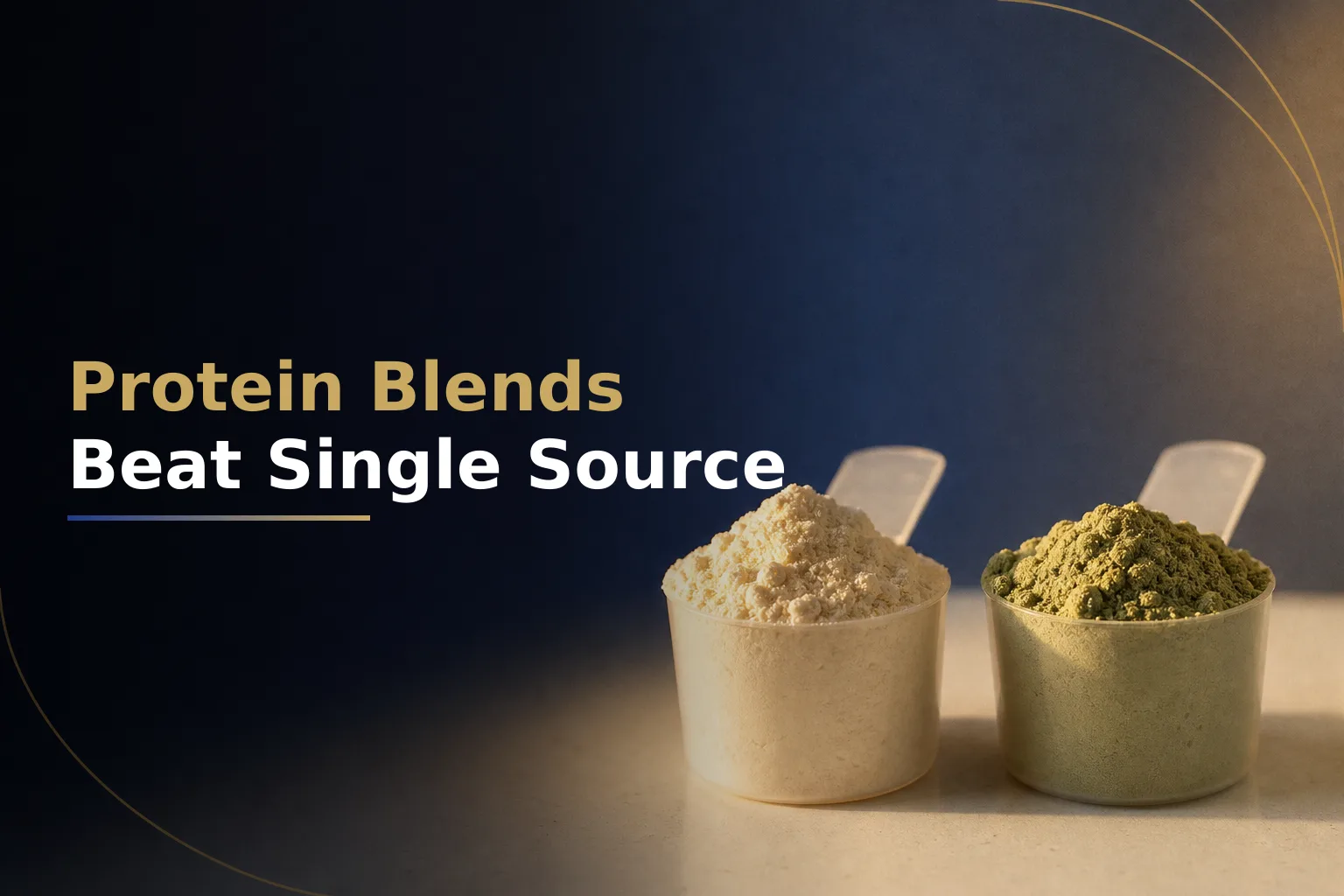
Protein supplements split into two groups: whey on one side, plant-based options like pea or rice on the other. Marketing has made money from that split. Research doesn't pick a side.
The real question isn't which protein is best, but whether mixing proteins with different amino acids and different digestion speeds works better than using just one. Human trials support this idea, and the answer comes down to biochemistry, not marketing.
The Amino Acid Gap in Single-Source Proteins
Every dietary protein is a chain of amino acids, nine of which are essential - meaning the body cannot synthesize them and must obtain them from food. Many plant proteins are limiting in at least one of these nine. Pea protein is low in methionine. Rice protein is low in lysine. Hemp is often low in both lysine and threonine.
These gaps matter. Methionine helps make glutathione, which protects your cells from damage. Lysine is needed to make carnitine, which helps your cells burn fat for energy. If you don't get enough of either one, your body doesn't work as well - but blood tests might not catch it.
Whey protein, derived from milk, carries all nine essential amino acids. But it has a different limit: speed. Whey is absorbed quickly, creating a high but brief spike in blood amino acids. For your muscles to keep building new protein and for steady energy, how long the amino acids stay in your system matters as much as the spike.
How Protein Quality Is Actually Scored
For decades, the standard metric was the Protein Digestibility-Corrected Amino Acid Score (PDCAAS), which had a basic flaw: it measured what left your body instead of what your small intestine actually took in. The Food and Agriculture Organization has since endorsed a replacement: the Digestible Indispensable Amino Acid Score (DIAAS), which measures what your small intestine actually absorbs - a better picture of what you really get.
By DIAAS, whey protein typically scores above 1.0, which is excellent. Most plant proteins alone score below 0.75. But when you mix plant proteins that fill each other's gaps - pea with rice, for example - their weak spots complement each other, and the blend can match a high-scoring animal protein. DIAAS shows this clearly in a way the old test didn't.
The Kinetics Argument: Fast, Slow, and Sustained
Protein scientists sort sources by how fast your body absorbs them. Whey is fast - absorbed quickly, creating a high but brief spike in blood amino acids. Casein, the other main milk protein, is slow - it releases amino acids over three to five hours. Most plant proteins are somewhere in between.
Your muscles build new protein in response to both how high the amino acid spike goes and how long it lasts. A fast protein might hit the target fast, but if it drops before your muscles finish building, you miss out. A blend of fast and slow proteins might trigger more muscle building than either one alone - not by being all-around better, but by fitting your muscles' needs more closely.
What the Human Trials Actually Showed
The most quoted study is Reidy et al. 2013, which gave resistance-trained men either a blend of soy, whey, and casein or whey alone - both with the same total protein. The blend triggered more muscle protein synthesis over five hours. The researchers noted that mixing proteins with different absorption speeds might keep amino acids in your blood longer than any single protein.
A double-blind crossover trial tested plant-only blends. Researchers compared blood amino acid levels after taking a high-quality plant blend versus whey. When the blend was designed to fix each protein's weak spots, the amino acid response matched whey. Design mattered: a poorly made plant blend didn't work.
A newer study went further, showing that a well-designed plant blend triggered muscle growth after exercise just as well as whey in trained people - something the field wouldn't have believed as a theory just fifteen years ago.
The Leucine Question
Leucine matters most for muscle growth. It activates mTORC1, the switch that starts building new muscle protein. Most researchers put the effective amount at 2 to 3 grams per serving, and whey hits that reliably. Most plant proteins give you less leucine at the same total protein amount.
A study tested plant proteins with and without added leucine versus whey. Boosting the leucine in a plant blend to match whey helped muscle growth significantly. The takeaway is clear: combining a leucine-rich dairy protein with plant proteins that fill each other's gaps tackles both problems at once.
Blends, Amino Acids, and Daily Energy
Most studies on protein blends focus on muscle growth. But protein does more than build muscle after workouts. Amino acids make neurotransmitters: tryptophan becomes serotonin, tyrosine becomes dopamine. Lysine and methionine make carnitine, which helps your cells burn fat for energy. If you're low on any of these amino acids for a long time, your body struggles quietly. The result often looks like general tiredness that you might blame on bad sleep or stress - and it's hard to connect to protein without looking closely at your diet.
If you see yourself in that description, the article on why afternoon energy crashes outlast a standard multivitamin covers related nutrient gaps that cause tiredness before showing up on blood tests. If you want to know how protein timing affects your thinking, the research on protein timing and the cognitive focus window explores these same amino acid pathways from a brain chemistry angle.
What to Look for in a Formulated Blend
If the research convinces you about protein blends, how do you pick a good one versus a marketing gimmick? Here are some benchmarks from the research:
- Total protein per serving should fall within the 20 to 35 gram range studied in most published trials.
- The label should show leucine content. If it doesn't, that's a red flag - the total protein amount doesn't tell you how much leucine you're getting with plant proteins.
- The label should list each protein source by name, not just call it a proprietary blend. You need to know what's in there to tell if the proteins work together.
- Look for third-party testing for heavy metals, especially for rice and pea proteins, which can pick up cadmium or lead from the soil they're grown in.
Ayurnomics's 14i Super Protein (Vanilla) follows this design with a whey and plant blend. For more options, see the Superfoods and Greens collection.
If you take prescription medicine, are pregnant, or are breastfeeding, talk to your doctor before adding a protein supplement. Protein needs vary a lot based on age, training, and health. Your doctor can tell you if a supplement fills a real gap or just repeats what you already eat.
¿Quieres más artículos como este? Únete al Círculo Íntimo y recibe una pieza cuidada cada domingo.