
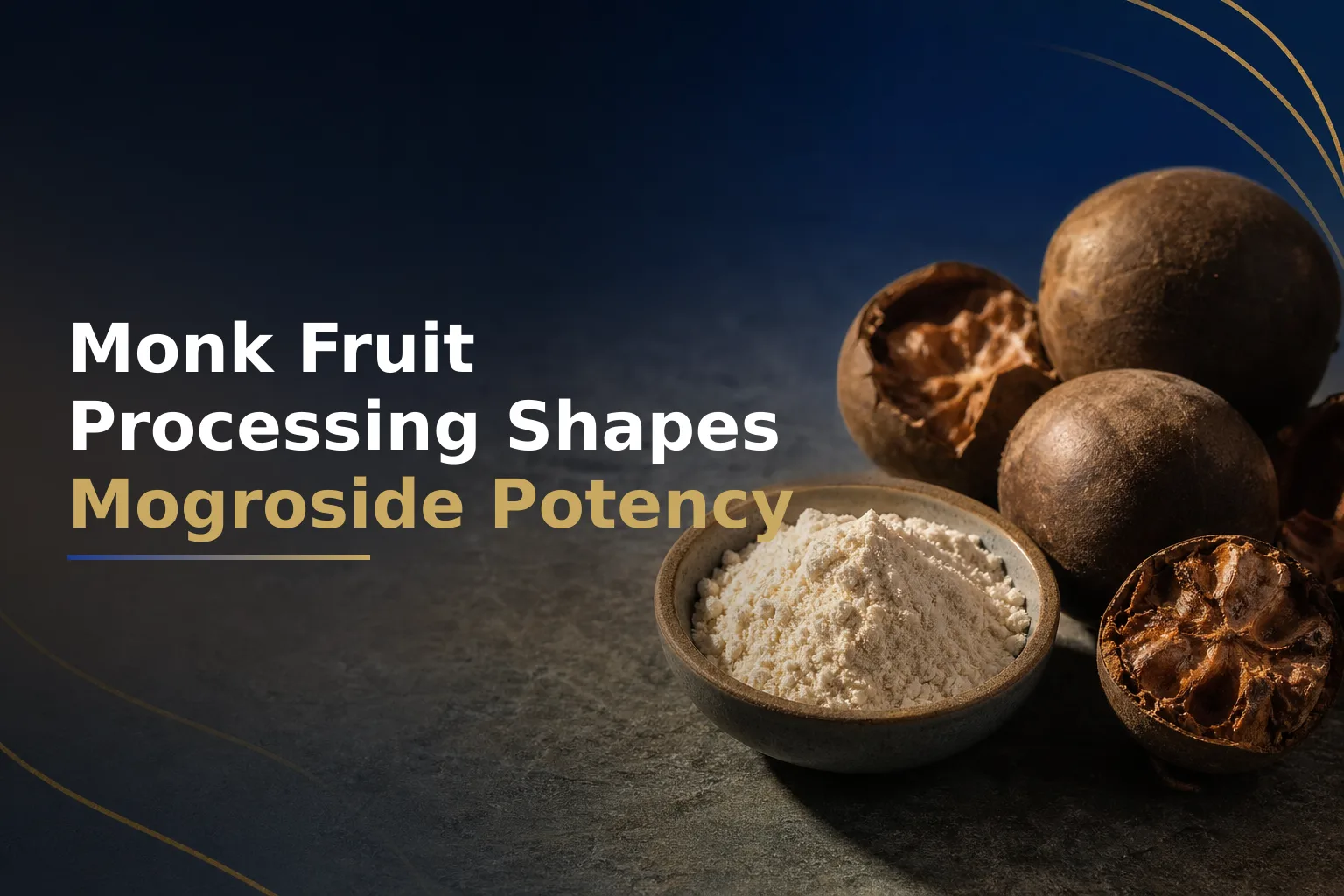
The whole fruit is unremarkable to look at. Siraitia grosvenorii, known in Mandarin as Luo Han Guo, produces a round, brownish-green fruit roughly the size of a lemon, grown almost exclusively in the Guangxi region of southern China. Inside the fruit, in concentrations that would barely register on a food label, sits a family of compounds called mogrosides. These triterpene glycosides are estimated to be several hundred times sweeter than sucrose at comparable concentrations, and they have attracted serious scientific interest for reasons that extend well beyond flavor.
But there is a gap between the fruit and the supplement. What happens between harvest and the finished extract determines whether the mogrosides in a product are present in meaningful quantities, in a chemically stable form, and at a purity level that regulatory bodies have assessed for safety. This gap shows whether sourcing discipline adds real value or amounts to marketing.
What the Raw Fruit Actually Contains
Fresh monk fruit contains mogrosides at roughly 0.55 to 0.65 percent of its total weight, according to FDA GRAS documentation for Siraitia grosvenorii extract. Within that mogroside fraction, five compounds appear in commercially relevant quantities - numbered mogroside II through mogroside V. Mogroside V is the dominant sweet compound and the one most studied for metabolic activity. The others contribute to the overall sweetness at lower potencies and with far less research behind them.
This starting amount matters because it determines what the final product can contain. A minimally processed juice concentrate product starts from a very different baseline than one made through multi-stage extraction and purification. Both can legally carry the label description monk fruit extract. The label alone does not tell you which you have purchased.
What Drying Does to the Mogroside Profile
The first major processing decision is how the fruit is dried before extraction. Traditional hot-air drying, which exposes the fruit to temperatures above 60 degrees Celsius for extended periods, degrades heat-labile mogrosides measurably. A 2022 chemical analysis published in PubMed (PMID 35586734) compared monk fruit products processed by different drying methods using high-performance thin-layer chromatography combined with chemometric analysis. Products dried at low temperatures retained significantly higher mogroside V content than those processed by traditional hot-air drying. Beyond the mogroside V figure, the complete chemical fingerprint - which mogrosides remain and in what amounts - also shifted between drying methods.
Low-temperature drying and freeze-drying approaches preserve more of the native mogroside profile. For a consumer or procurement buyer, if a manufacturer doesn't disclose the drying method, that's worth noting.
Extraction Grades and What the Numbers Mean
After drying, the fruit goes through water extraction and resin purification. The least-processed commercial grade - usually called MFE-25% - uses water extraction, pectinase treatment, concentration, and a single resin-column pass. The resulting powder contains approximately 25 percent mogrosides by dry weight. Further purification steps, including ion-exchange resin treatment and additional chromatography, push mogroside V concentrations to 50 percent and above. High-purity preparations used in some research settings can reach 95 percent by dry weight.
The EFSA safety opinion on monk fruit extract from 2019 distinguishes these grades explicitly and notes that toxicological data requirements differ by purity tier. The European Food Safety Authority found that standard commercial grades had an adequate safety profile for the food applications assessed, but that highly purified non-aqueous preparations require additional toxicological characterization before full approval. That distinction remains relevant: as of 2025, highly purified mogroside extracts remain unapproved for food use in the European Union, largely due to remaining data gaps and the absence of completed industry applications, as documented in a 2025 regulatory analysis in PMC. In the United States and China, monk fruit extract at established purity grades has received regulatory clearance as a non-nutritive sweetener.
What the Research Shows on Metabolic Activity
The metabolic interest in mogrosides has focused on three mechanisms: effects on blood sugar after eating, insulin secretion, and liver fat metabolism. In each case, the extraction grade of the product used in a study matters for how findings can be interpreted.
On blood sugar and insulin, a 2025 PRISMA-guided systematic review of randomized controlled trials identified five RCTs examining monk fruit extract's effects on metabolic parameters. Across these trials, monk fruit extract showed reductions in blood sugar levels after eating and in insulin responses. The review authors noted no severe adverse effects in the studies they examined. A separate human study published in the International Journal of Obesity compared blood sugar and insulin responses to beverages sweetened with monk fruit, aspartame, stevia, and sucrose. Monk fruit-sweetened beverages showed no significant differences in blood sugar or insulin compared to water-only controls, while sucrose produced the expected rise. These findings apply to standardized extracts. If a product doesn't list mogroside V content per serving, you can't evaluate it fairly against the published trial data. A related piece in this journal examines the insulin response evidence for monk fruit in detail.
On insulin secretion at the cellular level, a 2011 in vitro study (PMID 21351724) found that mogroside V isolated from Luo Han Guo extract stimulated insulin secretion in pancreatic beta cells. This is a mechanistic observation from a cell model - it does not establish clinical dosing or predict outcomes in human subjects with metabolic conditions.
On liver metabolism, a 2018 mouse study (PMC6222773) found that mogrosides reduced body weight and liver weight in mice fed a high-fat diet, decreased liver fat accumulation, and increased phosphorylation of AMP-activated protein kinase (AMPK) in liver tissue. A related study (PMC7210551) found that mogroside V specifically protected against liver fat buildup in mice via the same AMPK pathway. Both are preclinical findings. The distance between a high-fat-diet mouse model and clinical liver health recommendations in humans is substantial, and these studies should be read as mechanistic signals rather than clinical guidance. Readers interested in how the evidence standard applies to hepatoprotective ingredients more broadly will find the hepatoprotection evidence reviewed for NAC and silymarin a useful reference point.
Four Questions a Responsible Label Should Answer
A quality monk fruit extract - whether in a food product or a supplement - should clearly show all four of the following, either on the label or through a published certificate of analysis:
- Mogroside V percentage by dry weight - not monk fruit extract listed as a total weight. A product at 25 percent mogroside V is categorically different from one at 50 or 80 percent. Total extract weight tells you nothing about active compound content.
- Drying method - low-temperature or freeze-dried processing preserves the mogroside profile better than high-heat hot-air drying. If the manufacturer doesn't disclose this on the label, it should be available on request before purchase.
- Extraction method and solvent disclosure - resin-column purification with aqueous ethanol desorption is the standard commercial method. Products requiring additional chromatography steps for higher purity grades should carry documented solvent residue testing results.
- Heavy metal testing results - the FDA GRAS documentation for monk fruit extract specifies a lead limit of 0.5 mg/kg and arsenic at 0.4 mg/kg. A certificate of analysis showing metals tested below those thresholds is standard practice for a responsibly sourced ingredient.
Dose transparency matters equally. The trials in the PRISMA systematic review used monk fruit preparations standardized to mogroside V content - not to total extract weight. These are different measurements. A label stating only the total extract weight per serving, without specifying mogroside V percentage, cannot be evaluated against the published trial evidence in any meaningful way.
Ayurnomics's Monk Fruit Sweetener lists mogrosides as its active compound, dosed per manufacturer directions. The mogroside V content and purity information are on the product label - a basic requirement for any monk fruit supplement worth considering.
For readers approaching monk fruit as part of a Weight Management strategy or as a way to reduce total sugar intake without sacrificing taste, the evidence supports considering it. The sweetness is genuine. The metabolic signals from human trials are consistent across the reviewed studies. What separates a quality product from a generic one is the sourcing record - drying method, extraction grade, and third-party metal testing. No front-panel claim can substitute for it. For a recipe application that uses monk fruit's sweetness without added concentrates, the monk fruit and green tea elixir in this journal offers a calibrated use case.
If you take prescription medication for blood sugar management, liver conditions, or any metabolic disorder, or if you are pregnant or breastfeeding, speak with your clinician before adding a concentrated mogroside product to your routine.
Want more like this? Join the Inner Circle for one considered piece every Sunday.