
The average adult eating a diet in Japan takes in roughly 16 mg of quercetin per day from food, according to a dietary analysis of quercetin intake published in Nutrients by Kimira et al. (2015). European and US estimates run higher - around 25 to 40 mg on typical mixed diets - but the range is similar overall. Clinical trials studying quercetin's relationship to immune and inflammatory markers have used daily doses of 500 mg to 1,000 mg. The gap between dietary intake and research-level dosing isn't a failure of food. It's a difference between what whole foods contribute and what a supplement delivers, and understanding both changes how you build the daily habit.
What the Food Data Shows
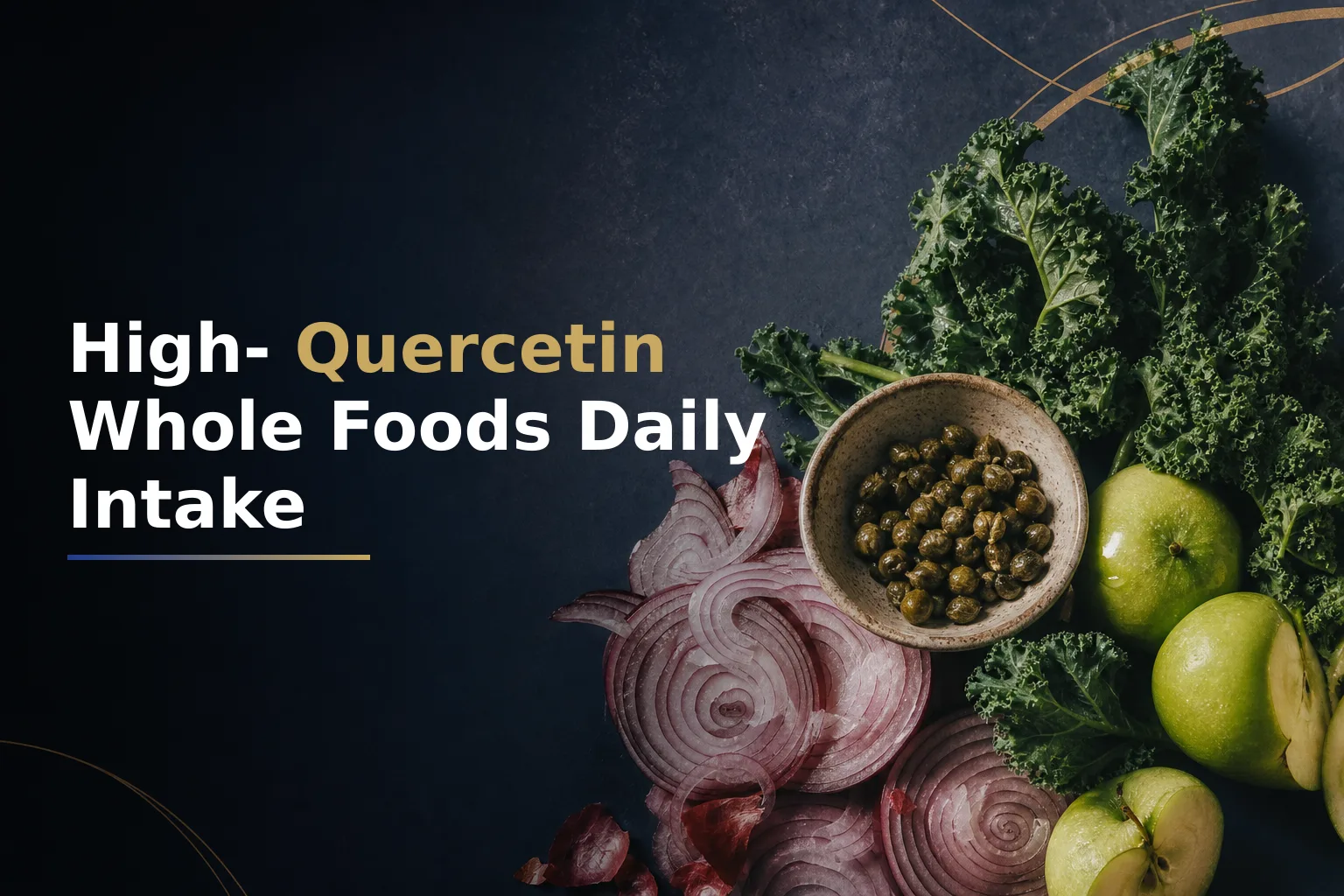
Quercetin is a flavonol (a type of polyphenol) and appears across a wide range of plant foods. Concentration varies by food type, variety, and preparation. A 2023 review in Nutrients placed capers among the most concentrated single sources, at roughly 234 mg per 100 g in their dried form. Red and yellow onions - far more commonly eaten in volume - contain approximately 30 mg per 100 g raw weight, with the highest concentrations in the outermost rings.
| Food | Approx. quercetin per 100 g or 100 mL | Notes |
|---|---|---|
| Capers (dried) | ~234 mg | Rarely eaten in large amounts |
| Red onion (raw) | ~30 mg | Outer rings richest in flavonols |
| Kale (raw) | ~20 mg | Also a meaningful kaempferol source |
| Apple (with peel) | ~4 mg | Peel holds the majority of flavonols |
| Brewed green tea | ~2 mg per 100 mL | Variable by steep time and leaf grade |
Approximate figures based on data summarized in Ullah et al., Nutrients 2023. Values vary by variety, growing conditions, and freshness.
A diet built around these foods (half a large red onion, a cup of kale, a whole apple with its skin, two cups of green tea) might deliver 70-100 mg of quercetin on a good day. That's real flavonol exposure. It's still far short of 500 mg.
How the Body Absorbs Quercetin From Food
Absorption depends less on the total milligram count and more on the glycoside form quercetin takes inside each specific food. A pharmacokinetics study by Hollman et al. (2012) found that quercetin from onions reached peak plasma levels in under one hour after ingestion, while quercetin from apples took around two and a half hours, and quercetin rutinoside - a form found in some supplements and foods - peaked at nine hours. The difference comes down to the sugar group attached to the quercetin molecule. Onions contain quercetin primarily as a glucoside, which intestinal glucose transporters recognize and move across the gut wall efficiently. Apple peel contains quercetin conjugated to arabinoside, galactoside, and rhamnoside sugars, which require microbial processing in the large intestine before absorption.
A related finding from the bioavailability literature: fat co-ingestion boosts quercetin uptake, consistent with how lipophilic polyphenols generally behave, as reviewed by Bmarquart et al. (2017). In practical terms, this is a reason to dress the salad. An onion-heavy dish finished with olive oil does more for quercetin uptake than a plain raw-onion serving.
Three Recipes Built Around Quercetin-Rich Ingredients
These aren't therapeutic protocols. They're practical meals designed to build a higher-flavonol baseline from whole food - a foundation that works alongside, not instead of, a targeted supplement when research-level dosing is the goal. Each includes fat alongside the quercetin-rich ingredient, which is consistent with the absorption pattern above.
Red Onion and Caper Vinaigrette
Finely dice half a small red onion (roughly 40 g) and chop 1 tablespoon of rinsed capers. Whisk together with 2 tablespoons of extra-virgin olive oil, 1 tablespoon of red wine vinegar, a pinch of flaked salt, and cracked black pepper. Let the mixture rest for ten minutes before using - the acid softens the raw bite of the onion without cooking away its flavonol content. Spoon over roasted vegetables, grilled white fish, or a warm lentil salad. Estimated quercetin from the onion and capers in this quantity: roughly 30-50 mg per serving, with variation depending on onion variety and freshness.
Kale and Unpeeled Apple Slaw
Shred 80 g of raw kale (ribs removed) and slice one medium apple with its peel intact (around 150 g). Toss with 1 tablespoon of tahini, 1 tablespoon of lemon juice, a teaspoon of raw honey, and 2 tablespoons of toasted pumpkin seeds. The tahini provides fat; the lemon keeps the apple from oxidising and adds brightness. Quercetin from the kale and unpeeled apple combined: roughly 20-28 mg per serving. Keeping the peel is essential - it's where most of the apple's flavonol content is, as the 2023 review makes clear.
Buckwheat and Roasted Red Onion Bowl
Cook 80 g dry buckwheat groats according to packet directions. Halve two medium red onions (roughly 300 g total), drizzle with olive oil, and roast at 200 C for 35 minutes until the cut edges caramelize. Some quercetin is lost during heat processing - something to remember for any dietary estimate - but the volume of onion used here means the contribution stays substantial even post-cooking. Layer the cooked groats with the roasted onion, a handful of flat-leaf parsley, a squeeze of lemon, and an additional drizzle of olive oil. Buckwheat also contains rutin, a quercetin glycoside present in the grain itself, adding a modest background contribution that adds to the onion intake.
Where Dietary Intake Ends and Supplementation Begins
The food-based baseline described above is real. What it doesn't do is match the doses used in clinical research. A 2016 review in Nutrients summarizing quercetin's relationship to immune signalling and inflammatory markers found that the most consistent trial evidence came from supplemental doses of 500 mg to 1,000 mg per day - well above what diet alone delivers. At 70-100 mg from a well-designed diet, the shortfall is substantial.
For readers building a consistent daily habit around quercetin, Year-Round Quercetin Beats Reactive Allergy Protocols covers the evidence for continuity over seasonal or reactive dosing. For context on how quercetin pairs with other compounds at the mechanism level, Why Your Joint Stack Needs Curcumin Alongside Quercetin complements this piece.
Those using Ayurnomics's Quercetin Daily 1.0 G as part of their routine can treat the food contribution as a consistent daily background - roughly 70-100 mg established through the recipes above - and the 1 g supplement as the bridge between diet and research-level intake. Taking the capsule with a fat-containing meal aligns with what the bioavailability literature suggests for both food-sourced and supplemental quercetin.
On safety: a 2018 analysis by Andres et al. in Molecular Nutrition and Food Research found no significant adverse effects reported in human trials using supplemental quercetin at up to 1,000 mg per day. Longer-term data at very high chronic doses remain limited. Anyone taking prescription medication - particularly anticoagulants or immunosuppressants - should discuss adding a quercetin supplement with their clinician before starting, especially when dietary intake is already elevated.
For a deeper look at the dosing and timing evidence, Why Daily Quercetin Outperforms Reactive Immune Protocols examines how regularity of intake shapes plasma quercetin levels over time.
Putting It Together
A quercetin-rich diet and a supplement work in different ways. A diet delivers real flavonol exposure through varied glycoside forms, embedded in foods that shape how the molecule moves through your body. The recipes above make that exposure repeatable. Closing the gap to research-relevant doses, if that's the goal, requires a targeted supplement. The two approaches work together by design - they're complements, not competitors.
To explore the full range of evidence-studied compounds alongside quercetin, visit the Immunity and Wellness collection, or read across the Journal for in-depth reviews of individual ingredients and how they are formulated.
Envie de découvrir d'autres articles comme celui-ci ? Rejoignez le Cercle Privilégié et recevez un article soigné chaque dimanche.