
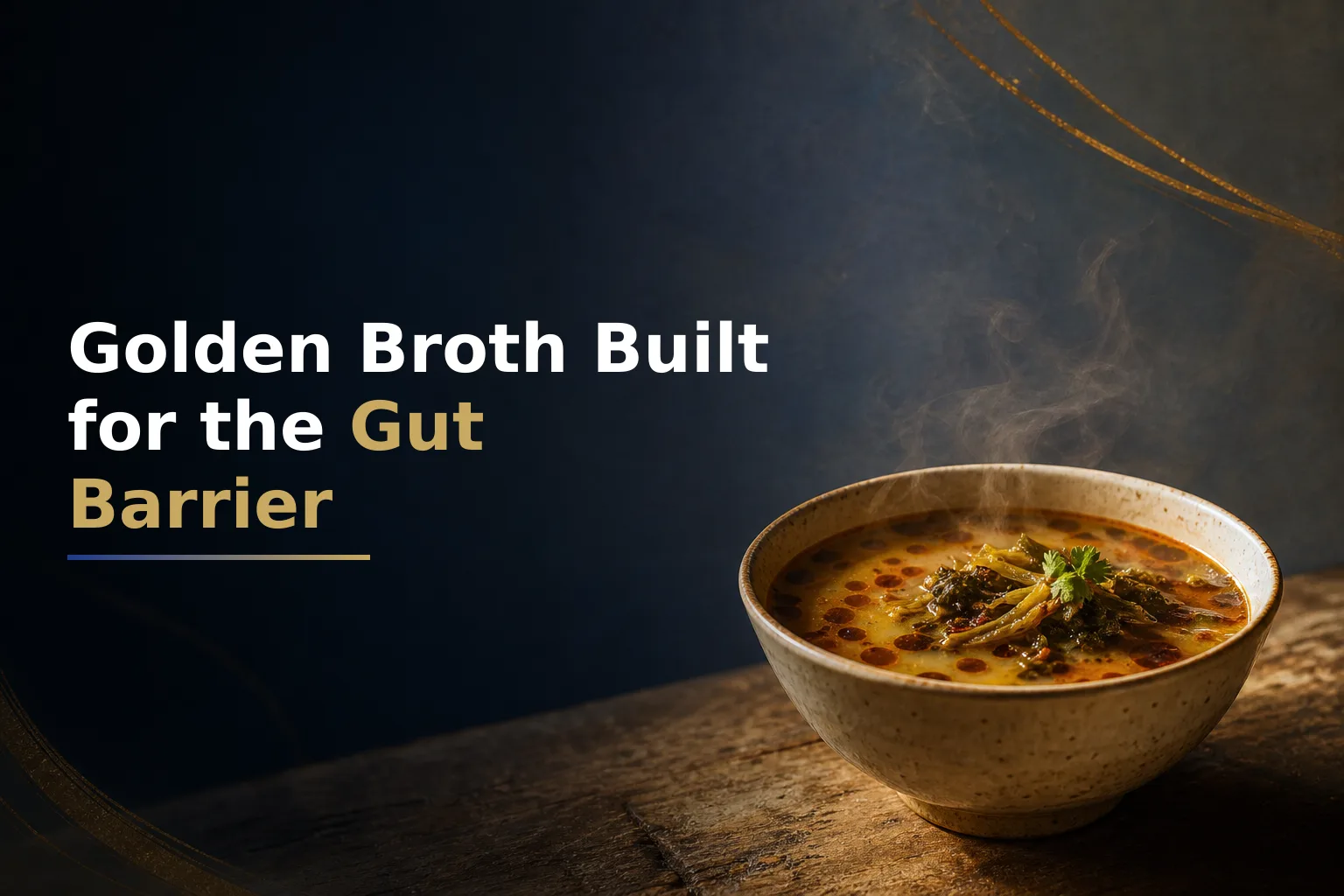
Most broths are a comforting afterthought. This one was built as an architecture problem.
The gut epithelial barrier is a single-cell lining held together by tight junction proteins. When these junctions weaken from inflammation or poor gut bacteria, molecules leak from the gut into the bloodstream that should stay out. This causes slow, building inflammation. Researchers are studying whether foods can help keep these junctions tight.
This recipe is based on four published research findings: curcumin from turmeric, thymoquinone from cold-pressed black seed oil, organic acids from fermented vegetables, and glycine-rich collagen from a long-simmered chicken carcass. Each ingredient is in this recipe because research supports it. The amounts balance out so no one ingredient takes over.
What the Research Says About Each Ingredient
Curcumin and Tight Junction Proteins
Curcumin is turmeric's main active compound. Researchers have studied it in cell cultures and animals for its effects on gut tight junction proteins. A 2017 paper in the American Journal of Physiology (PMID 28249988) found that curcumin activates the vitamin D receptor in gut cells, which increases the tight junction proteins ZO-1 and claudin-1 while reducing LPS-mediated permeability. A 2018 review in Food and Chemical Toxicology (PMID 29420166) confirmed that the barrier-protective effects work through two paths: tight junction stabilization and reduced inflammatory signaling at the gut lining.
A practical note on dose: dried turmeric powder is roughly 2-3% curcumin by weight, so 2 teaspoons (approximately 6 g) provides around 120-180 mg of curcumin - well below the 500 mg to 1 g doses used in most research. The broth contributes a food-level dose, not a research-level one. Fat helps your body absorb curcumin better. For more on how fat and piperine affect curcumin absorption, see the earlier piece on turmeric ghee with black pepper.
Thymoquinone from Black Seed Oil
Thymoquinone is the main active compound in Nigella sativa. A 2016 paper in the Journal of Ethnopharmacology (PMID 27247918) reviewed its effects on the digestive tract: it reduces intestinal spasms, works against H. pylori, and may protect the gut lining. A 2025 study found that thymoquinone improves gut epithelial injury by suppressing the JNK signaling pathway - a pro-inflammatory process linked to tight junction protein breakdown.
Add cold-pressed black seed oil to this recipe after ladling, never to the hot pot. High heat oxidizes thymoquinone, which reduces both its amount and likely its effect. One teaspoon (approximately 4-5 ml) as a finishing drizzle per bowl matches the lower end of the oil amounts used in published studies. Thymoquinone content varies by origin and pressing method. See the piece on thymoquinone levels by origin for what to look for on a label.
Fermented Vegetables and the Gut Metabolome
The case for fermented vegetables rests less on live bacteria than on what those bacteria leave behind. A 2024 study in the British Journal of Nutrition (PMID 39295909) found that regular fermented vegetable consumption shifted the gut metabolome more than it shifted microbiome composition, with more short-chain organic acids and indole metabolites linked to gut health. A 2025 study (PMC12093966) showed that the fermented cabbage metabolome - not the bacteria - protected gut cell monolayers against damage, suggesting that even heat-killed fermented vegetables may help gut barrier function.
In this recipe, add fermented vegetables cold, at serving. Heat kills the lactobacilli and breaks down many of the organic acids. Two tablespoons of kimchi, sauerkraut, or fermented daikon (approximately 50-75 g) matches the amounts studied in the metabolome research above.
Collagen Peptides and Barrier Integrity
Collagen is the main structural protein in the gut lining. Hydrolyzed collagen peptides are short collagen fragments that your body absorbs. An in vitro study in Food and Function (PMID 28174772) found that collagen peptide fractions reversed a TNF-alpha-induced decrease in intestinal barrier function by 43-69%, and reduced leakage by 52-87% in cell cultures. A 2023 study of 20 healthy adults (PMC9941265) found that 10 g per day of collagen peptides, taken before exercise, reduced the rise in blood LPS after exercise compared with placebo - blood LPS is a common measure of gut permeability in human studies.
A long-simmered chicken carcass yields gelatin, which is partially hydrolyzed collagen. Broth that sets to a gel when chilled indicates meaningful collagen extraction. A 3-4 hour simmer with joints and skin intact, plus a small amount of apple cider vinegar to help release collagen from bone, works well. For a standard 10 g dose matching the clinical trial, you can stir hydrolyzed collagen peptides directly into the hot broth at serving.
The Recipe
For the broth base (makes 2 servings)
- 1.2 kg chicken carcass, wings, or feet - joints intact
- 1.5 litres cold filtered water
- 1 medium yellow onion, halved
- 4 garlic cloves, bruised
- 1 tbsp fresh ginger, sliced
- 2 tsp ground turmeric
- 1/2 tsp freshly cracked black pepper
- 1 tsp fine sea salt
- 1 tsp apple cider vinegar
To finish each bowl
- 1 tsp cold-pressed black seed oil, drizzled over the broth after ladling
- 2 tbsp fermented vegetables (sauerkraut, kimchi, or fermented daikon), added cold
- 10 g hydrolyzed collagen peptides, stirred in while broth is still hot - optional if using a long-simmered joint-rich carcass
- Fresh lemon juice and additional sea salt to taste
Method
- Place chicken, water, onion, garlic, ginger, vinegar, and salt in a heavy pot. Bring to a bare simmer over medium heat.
- Skim any foam that rises in the first 10 minutes. Reduce heat to the lowest setting, partially cover, and simmer for 3-4 hours. The liquid should barely tremble.
- In the final 20 minutes, stir in the ground turmeric and black pepper.
- Strain through a fine-mesh sieve. Season to taste. The finished broth should be deep golden and slightly thick from the collagen. If it does not gel lightly when chilled, the collagen yield was low - dissolve 10 g of hydrolyzed collagen peptides into the hot broth at serving to standardize the dose.
- To serve: ladle into bowls. While the broth is above 60 C, stir in collagen peptides if using - they dissolve cleanly at this temperature. Allow the broth to cool slightly to around 50-55 C before drizzling the black seed oil; this preserves thymoquinone stability. Add fermented vegetables last, cold, on top or alongside the bowl.
The Order of Assembly Matters
Collagen peptides dissolve cleanly in hot liquid and should be added first, while the broth is at full temperature. Black seed oil comes second, once the broth has cooled slightly. High heat oxidizes thymoquinone, which is why you cannot reverse this step. Fermented vegetables come last and must stay cold; stirring them into hot broth kills the lactobacilli and breaks down many of the organic acids whose barrier-protective effects were studied at room temperature. The sequence follows the conditions under which each compound was studied.
What This Broth Does Not Do
This is a recipe, not a treatment protocol. The research cited here spans cell cultures, animal studies, and - for collagen peptides - one small human study of 20 participants. No combination of these four ingredients has been tested in a large randomized controlled trial for gut permeability in a patient population. The honest claim is narrower: each ingredient has a plausible, published mechanism for supporting tight junction integrity, and combining them in a single meal is a reasonable way to apply that evidence.
If you are managing a diagnosed gut condition, discuss dietary changes with your gastroenterologist, not a recipe column. For a related approach that applies the same evidence-first framework to bone mineral density, see the piece on sesame tahini and bone broth for calcium and copper absorption.
If you are pregnant, breastfeeding, or taking prescription medication - particularly anticoagulants or immunosuppressants - speak with your clinician before adding any of these ingredients in concentrated supplemental form.
For a broader view of the Immunity and Wellness range, the collection page organizes each product by active ingredient and links to the sourcing notes behind each formulation.
Vuoi altri contenuti come questo? Unisciti all'Inner Circle e ricevi un articolo curato ogni domenica.