
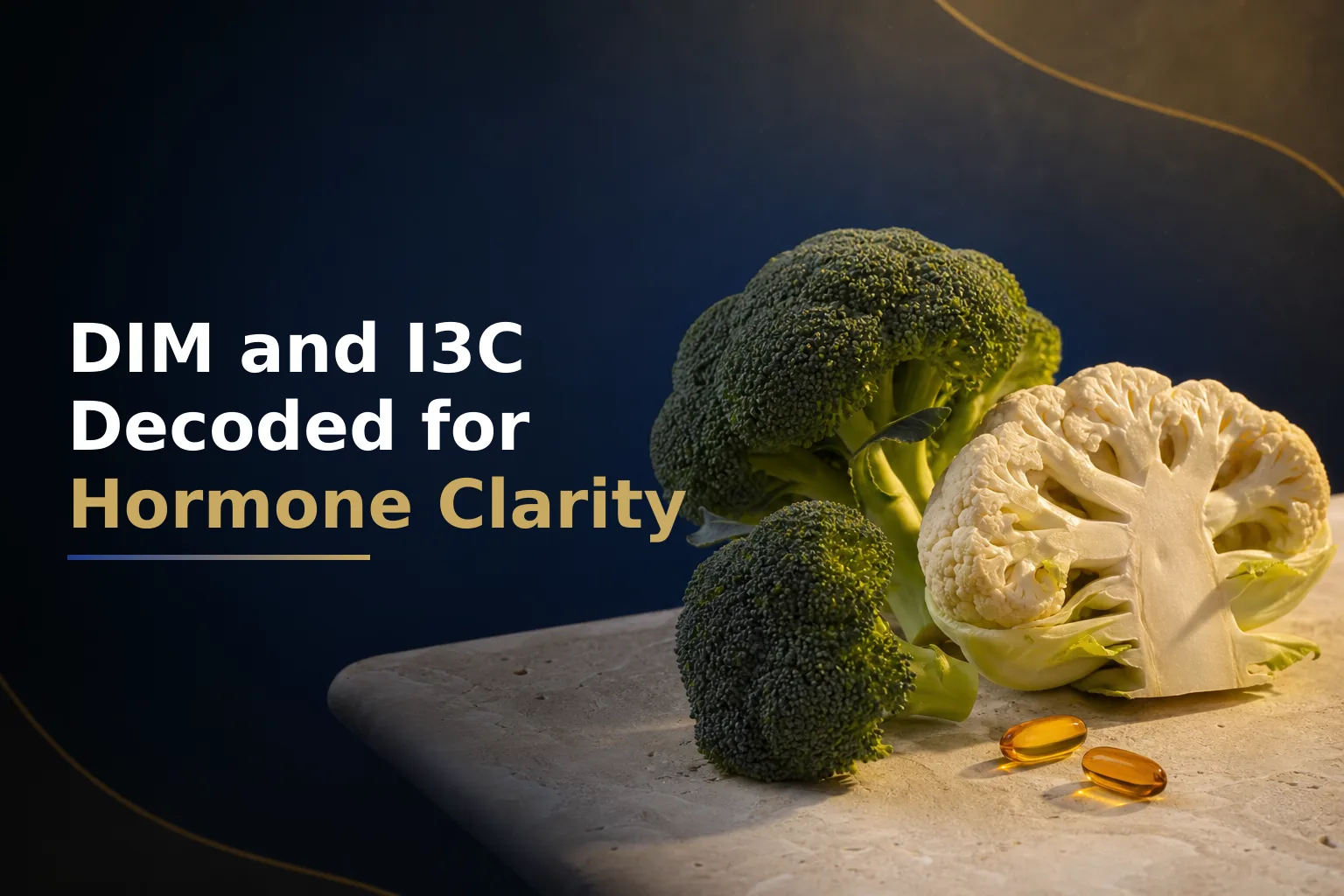
Broccoli, kale, cauliflower, and Brussels sprouts have been studied for decades. Scientists look at compounds in these vegetables that affect how your body handles estrogen. Two main compounds get attention: indole-3-carbinol (I3C) and 3,3'-diindolylmethane (DIM). You can now buy them as concentrated supplements. They are related but different - and that matters if you're choosing between them.
Dr. Naomi Reade is a clinical endocrinologist. She answers questions from patients who bring cruciferous extract labels to her clinic and worry about hormone clearance. This edited interview is from the Ayurnomics Journal series on women's hormonal research.
Are I3C and DIM Actually Different Compounds?
Yes. I3C is what you find in cruciferous vegetables before they reach your stomach. When I3C hits your acidic digestive tract, it changes through condensation reactions. One major product is DIM. I3C comes first, and DIM comes after. But the conversion is not clean. Taking I3C as a supplement also makes other byproducts alongside DIM, and we don't fully understand some of these secondary molecules.
The structural difference creates a pharmacokinetic difference. I3C leaves your bloodstream quickly - around one to two hours. DIM stays much longer, with a half-life closer to four to eight hours according to published comparative review data. For dosing frequency, that matters.
What Has Actually Been Studied in Humans?
Both compounds have been tested for their effect on the 2:16 ratio - the ratio of 2-hydroxyestrone to 16-alpha-hydroxyestrone in urine. These are breakdown products of estradiol. The 2-hydroxy pathway makes weaker estrogen metabolites. The 16-alpha pathway makes metabolites that bind to estrogen receptors more tightly. A shift toward more 2-hydroxylation is generally considered better in hormone metabolism research.
For I3C, a phase I study of 17 women at high breast cancer risk found a 66% increase in the urinary 2:16 ratio at 400 mg daily over four weeks. The same study tested 800 mg daily - and found no extra improvement. That matters. More is not always better.
For DIM, a randomized placebo-controlled trial enrolled 130 women taking tamoxifen. They got either DIM at 150 mg twice daily or placebo for 12 months. The DIM group saw favorable shifts in estrogen metabolite profiles and more sex hormone-binding globulin. That trial lasted a full year - longer than most supplement studies.
An earlier pilot study of patients with thyroid proliferative disease used 300 mg of DIM daily for 14 days. It found increases in the 2-hydroxy estrogen fraction in urine. The group was small and specific, but the metabolite signal matched the broader pattern in the research.
Why Does Bioavailability Matter So Much Here?
Because what's on the label often doesn't match what actually gets into your bloodstream - and it varies a lot. I3C taken by mouth has bioavailability between 10 and 35 percent. Stomach pH, gut bacteria, and what you ate matter. Standard crystalline DIM absorbs poorly too: comparative pharmacokinetic data show one to twenty percent absorption from standard preparations, with big differences between people.
Better formulations help. Absorption-enhanced preparations use phosphatidylcholine, microencapsulation, or other delivery systems. They get higher and more consistent blood levels than crystalline DIM, according to single-dose pharmacokinetic work. Doses from 50 to 300 mg of an absorption-enhanced formulation were well tolerated, with mild stomach effects at 300 mg in some people.
A lower dose from a good formulation often beats a higher dose from a powder that doesn't absorb well. Keep that in mind when comparing products.
What Doses Are You Looking At in the Research?
For I3C, most human studies use between 200 and 800 mg daily. The 400 mg daily dose is the clearest reference point - it created the biggest 2:16 shift in the phase I study, was well tolerated, and fits with dose-ranging work in the prevention research.
For DIM in absorption-enhanced form, clinical trials use 75 mg to 300 mg daily. The 150 mg twice-daily protocol from the 12-month tamoxifen trial is the most useful reference. It worked for metabolite changes and was well tolerated over the full year. Products combining I3C and DIM - like Ayurnomics's Cruciferex Daily 425 - target both the I3C conversion pathway and the more stable DIM output. Follow the manufacturer's directions and talk to your doctor if you take any hormone-related prescriptions. Combined formulations have less research than each compound alone, and you should know that before you start.
Who Should Not Take Either Without a Doctor?
Anyone on tamoxifen, aromatase inhibitors, or prescribed hormone therapy needs to talk to their doctor first. These compounds affect estrogen, and we don't know much yet about drug interactions. The tamoxifen trial above took place under medical supervision with regular check-ups - it's not a guide for taking supplements on your own while using cancer treatment.
Don't take these while pregnant. Clinical studies excluded pregnant women, and both I3C and DIM affect estrogen pathways, so be careful. The same goes for breastfeeding. If you take prescription drugs, are pregnant, or are breastfeeding, ask your doctor before starting either compound.
What About Getting These Compounds From Food?
Cruciferous vegetables have much less I3C than the doses used in clinical trials. Cooking reduces glucosinolate content even more - I3C forms from glucosinolates when you chew and digest, so cooked vegetables give less than raw. You can't realistically get 400 mg daily from food alone. Whole vegetables still matter. Cruciferous vegetables have phytochemical complexity that a capsule can't match. Research on eating cruciferous vegetables looks at a different scale than supplement trial evidence. Both touch the same biological pathway in different ways.
If you want to read more, check out the Journal piece on green tea extract and estrogen clearance. The piece on spearmint tea and hormonal balance is useful if you manage androgen-dominant profiles and estrogen metabolism concerns.
If you're thinking about a cruciferous extract as part of a bigger approach to Hormonal Balance, check the Cruciferex Daily 425 product page for formulation and sourcing details. Talk to your doctor about your own situation.
Envie de découvrir d'autres articles comme celui-ci ? Rejoignez le Cercle Privilégié et recevez un article soigné chaque dimanche.