
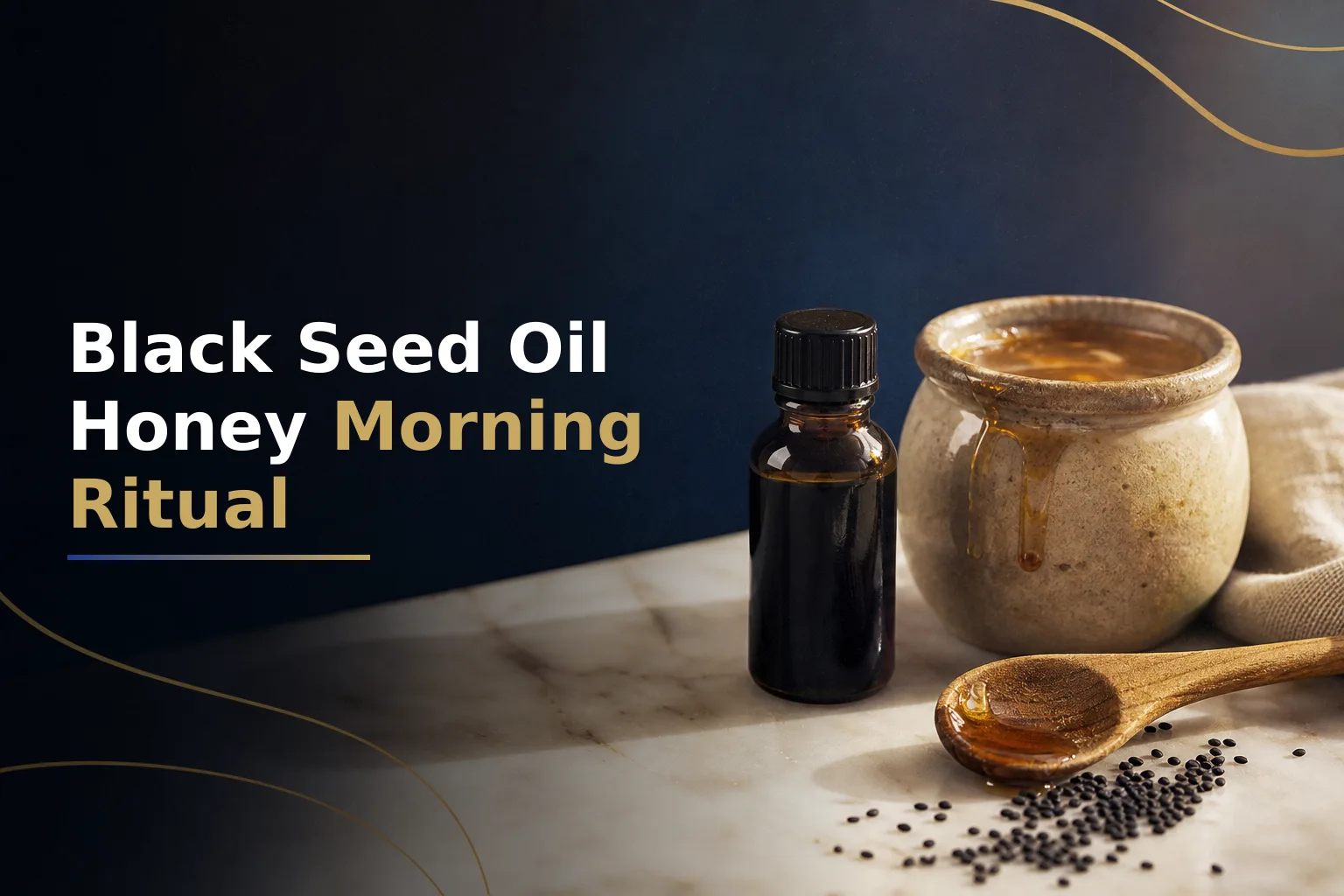
The ritual is simple: a small amount of black seed oil stirred through raw honey, taken each morning before breakfast. It's worth looking at because the science behind how your body absorbs it actually works.
What Thymoquinone Needs to Cross the Gut Wall
Thymoquinone's lipophilic nature is what matters for its pharmacology. A pharmacokinetic study in a rabbit model found oral bioavailability at approximately 58%, with an absorption lag time of around 23 minutes and protein binding estimated above 99%. That lag time shows how much the compound depends on bile salt and intestinal fat to cross the gut wall. Without enough fat in your digestive system, your body absorbs less of it, and it takes longer.
Lipid-based delivery systems show how this works. Studies of nanostructured lipid carriers with thymoquinone show bioavailability two to four times higher than with water alone. The lipid carrier helps absorption through your intestinal lymphatic system, skipping your liver's first-pass metabolism. For anyone taking black seed oil, eating dietary fat at the same time is the closest thing to that lipid environment. A 2017 Frontiers in Pharmacology review called thymoquinone's lipophilicity one of its main limitations when oral dosing is poorly designed - like taking it on an empty stomach with water.
Where Honey Fits In - and Where It Does Not
Honey is not a pharmacokinetic enhancer. No study has measured whether honey actually raises thymoquinone levels in your blood. It's simpler: honey makes it taste better, so you'll stick with it. Black seed oil tastes sharp and bitter - thymol-forward - and most people can't take it daily without something to mask the taste. Honey masks the taste without adding water, which would dilute the fat in your stomach and speed things through your gut - both problems for a lipophilic compound.
One study of this combination matters. A randomized controlled trial studied the combination of Nigella sativa and honey for clearing gastric Helicobacter pylori infection in a specific population. In one part of the trial, the combination cleared H. pylori as well as triple antibiotics. It's just one study in a narrow situation, not a general claim about treatment, but it shows the two together were safe for weeks - which matters for a daily practice.
Building the Ritual Around What the Pharmacology Requires
Your daily ritual should follow what the absorption science says. A few principles make sense.
- Take it with or just before a fat-containing meal. Breakfast is the practical anchor. Eggs, full-fat yogurt, nut butter, avocado, or olive oil on bread all provide the lipid environment that thymoquinone's absorption pathway depends on. An empty stomach with water doesn't work for a lipophilic compound.
- Avoid adding it to very hot liquid. Thymoquinone is sensitive to heat and prone to oxidation. If a warm drink is part of your morning routine, let it cool before adding the oil. This is a real chemical concern, not just theory.
- Use raw rather than processed honey. Processed honey is mostly sucrose with minimal secondary compounds. Raw honey keeps native flavonoids and phenolic acids in quantities that vary by floral origin. This is just about ingredient quality.
- Keep the dose consistent, day to day. Thymoquinone's 23-minute lag and high protein binding mean it distributes slowly, not in sharp peaks. Skip days and you won't get the same result as taking it daily for weeks.
Ayurnomics's BSOFit Black Seed Oil is standardized for thymoquinone from Nigella sativa. Follow the label for serving size because thymoquinone levels vary by origin and cold-pressing method. The morning practice here - oil in honey, eaten with a fat-containing breakfast - reflects the absorption science, not tradition.
What the Evidence Says About Sustained Daily Dosing
A 2018 systematic review found about 76 clinical trials on black seed or thymoquinone. Of those, 31 were randomized, double-blind, and placebo-controlled. Those trials showed changes in inflammatory markers and immune cells after eight to twelve weeks of daily use - not after a few days. That's how long it takes. The question isn't what one dose does, but what twelve weeks of daily use might do.
A 2022 randomized, double-blind, placebo-controlled trial tested the safety of a thymoquinone-rich black cumin oil in healthy adults at different doses. No serious side effects were seen. It's about safety, not whether it works, but it shows it's tolerable for months of daily use.
For how origin and cold-press method affect thymoquinone levels, see the Journal piece on thymoquinone levels and origin. For the evidence behind fat co-ingestion specifically, see the earlier analysis of why thymoquinone absorption depends more on fat than dose.
A Note on Drug Interactions and Clinical Supervision
Thymoquinone may affect CYP450 enzymes, which break down many prescription drugs. A 2022 study flagged possible interaction with warfarin. If you take anticoagulants, immunosuppressants, blood pressure drugs, or any prescription drug with a narrow therapeutic window, talk to your doctor before starting black seed oil. Pregnant or breastfeeding people should also ask their doctor first. There's not enough safety data for pregnancy to say either way.
If you're building a daily immunity and wellness approach, this structure - fat at dosing, honey as carrier, morning timing - is grounded in the absorption science. See BSOFit Black Seed Oil from Ayurnomics for a standardized option.
Möchten Sie mehr davon? Treten Sie dem Inner Circle bei und erhalten Sie jeden Sonntag einen sorgfältig kuratierten Beitrag.