
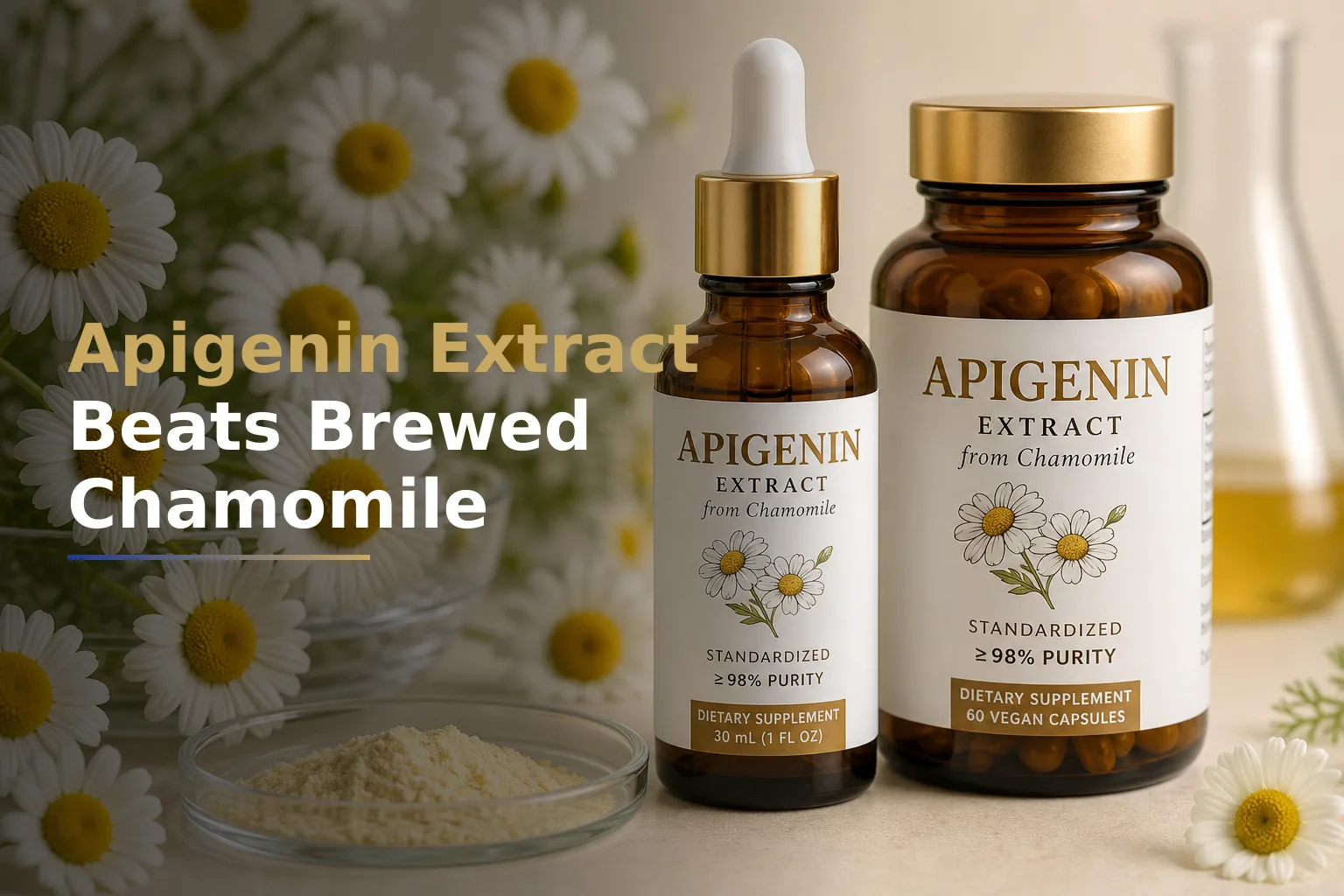
Chamomile tea comes in many forms. Dozens of brands sell it - some in paper sachets, some loose-leaf - and most promise better sleep and calm. Brewing a cup before bed feels good: the warmth, the scent, the signal to wind down. But brewed tea doesn't guarantee how much of the key compound you get in each cup.
That compound is apigenin. The difference between a brewed cup and a standardized extract matters. Brewed tea gives you unpredictable amounts of apigenin. That makes it hard to tell if your nightly cup is actually helping or if you just happened to sleep well that night.
The Compound Behind the Claim
Apigenin is a flavone in chamomile flowers, parsley, and other plants. Researchers have studied apigenin more than other compounds in chamomile because of how it affects the brain. A pharmacological study in Biochemical Pharmacology found that apigenin binds to the benzodiazepine receptor site on GABA(A) receptors - the same receptors that prescription sleep drugs target, but with much weaker effects and no risk of addiction.
This binding is why chamomile might help with sleep. GABA(A) receptors control the brain's shift from being awake to falling asleep. Apigenin modulates these receptors - partially, mildly, and in a way you can reverse - which is why researchers study it as a sleep aid. Research in cultured brain cells showed how apigenin affects GABA signaling. The effect was dose-dependent and was blocked by a drug that stops benzodiazepines from working, confirming it works on the receptor.
Why Brewed Tea Doesn't Reliably Deliver a Dose
Knowing apigenin is the key compound doesn't mean chamomile tea reliably gives you enough. A 2021 study in Antioxidants tested six commercial chamomile products and found big differences in phenolic composition across brands, including wide variation in apigenin content. Products with the same label showed different chemical profiles depending on which chamomile species was used, how the plant was processed, and how it was extracted.
Brewed tea adds more variables on top of what's already in the dried plant: water temperature, steep time, how many dried flowers per sachet, product age, and storage all affect how much apigenin ends up in your cup. Research on chamomile's effects in Phytotherapy Research noted that chamomile preparations differ based on species, extraction method, processing, and the food matrix - and infusions, extracts, powders, and essential oils are not all the same pharmaceutically.
The result: two cups of chamomile from different brands - or the same brand on different nights - may give you very different amounts of apigenin. That's not a problem if you drink chamomile for the ritual and the calming effect. It is a problem if you want to know whether a consistent amount is actually helping you sleep.
What Standardization Actually Locks In
A standardized chamomile extract specifies the minimum apigenin content per unit. Manufacturers test raw materials, adjust the extraction and concentration process, and check the final product against the declared figure. That minimum matters because it turns a variable input into something you can count on.
This difference shows up in research. A 2011 randomized, double-blind, placebo-controlled pilot trial tested 34 adults with chronic insomnia. They took either 270 mg of a standardized chamomile extract twice daily (540 mg per day) or a placebo for 28 days. Each 90 mg of the extract had at least 2.5 mg of apigenin; lab testing found about 3.9 mg of apigenin per 90 mg of extract. The researchers found no major differences between groups on sleep diary measures like total sleep time, sleep efficiency, and how long it took to fall asleep. Chamomile did show small improvements in daytime function. The authors said the study was underpowered and called for larger trials.
The key point here is about how they designed the study. Researchers could design, describe, and repeat this trial because they could specify the dose. A study using brewed tea would have no way to measure this. The chamomile group received a measured amount of apigenin per day; the placebo group did not. You can only design a study this way with a standardized form.
The Bioavailability Layer
Standardized extract removes one uncertainty - how much apigenin you get when you take it - but absorption adds more complexity. In chamomile plant material, apigenin comes mostly as glycosides: bound to sugar molecules that your intestines need to break down before you can absorb the active form. This breakdown process varies based on your gut bacteria and how fast food moves through you, and it affects both tea and extract. The difference is that with extract, you know the starting amount.
Animal data gives some hints about timing. Research scaling animal data to humans estimated a half-life of roughly 8.95 hours for apigenin in the human body - an estimate from animal studies, not direct human testing. We have very few human pharmacokinetic studies on apigenin, and that's important to remember when you see dosing claims. What we do know is that apigenin reaches peak blood levels in a window before sleep and stays detectable through the night, but the exact kinetics of supplement doses need more study in people.
Reading the Sourcing Gap
The extract-versus-whole-plant question comes up in other supplement categories too. It's like the discussion around EGCG stability in green tea extracts, where standardizing the active compound - not just the total dose on the label - determines what you reliably get per serving. In both cases, the sourcing choice comes before any question of whether it works. You can't tell if a compound is working at a given dose if the dose is unknown.
With apigenin, the question is complicated by chamomile's dual role. It's both a supplement and a culinary and cultural staple with its own ritual value. These don't conflict. You can keep a chamomile tea habit for its sensory and behavioral benefits - and these are real benefits - while choosing a standardized extract when you want apigenin delivery to be consistent. The two uses serve different purposes and work together.
For details on how to time an apigenin supplement in your sleep routine, see when to take apigenin for sleep. For more on treating apigenin as a consistency habit rather than a last-minute sleep aid, see the apigenin sleep ritual piece.
Choosing a Source
If you want the consistency of a standardized extract instead of the unpredictability of brewed tea, the form matters and so does the manufacturing standard. Ayurnomics's Apifit Chamomile Apigenin provides apigenin from chamomile, taken as directed. Since apigenin affects GABA receptors, talk to your doctor if you take sedative drugs, anti-anxiety drugs, or antihistamines, or if you're pregnant or breastfeeding. These interactions haven't been studied as closely in the supplement world as they have in drug trials, so caution makes sense.
If you want to explore the full range of sourced and dosed formulations in this category, browse the Sleep and Stress collection, where sourcing notes and dose information come with each product.
Want more like this? Join the Inner Circle for one considered piece every Sunday.